
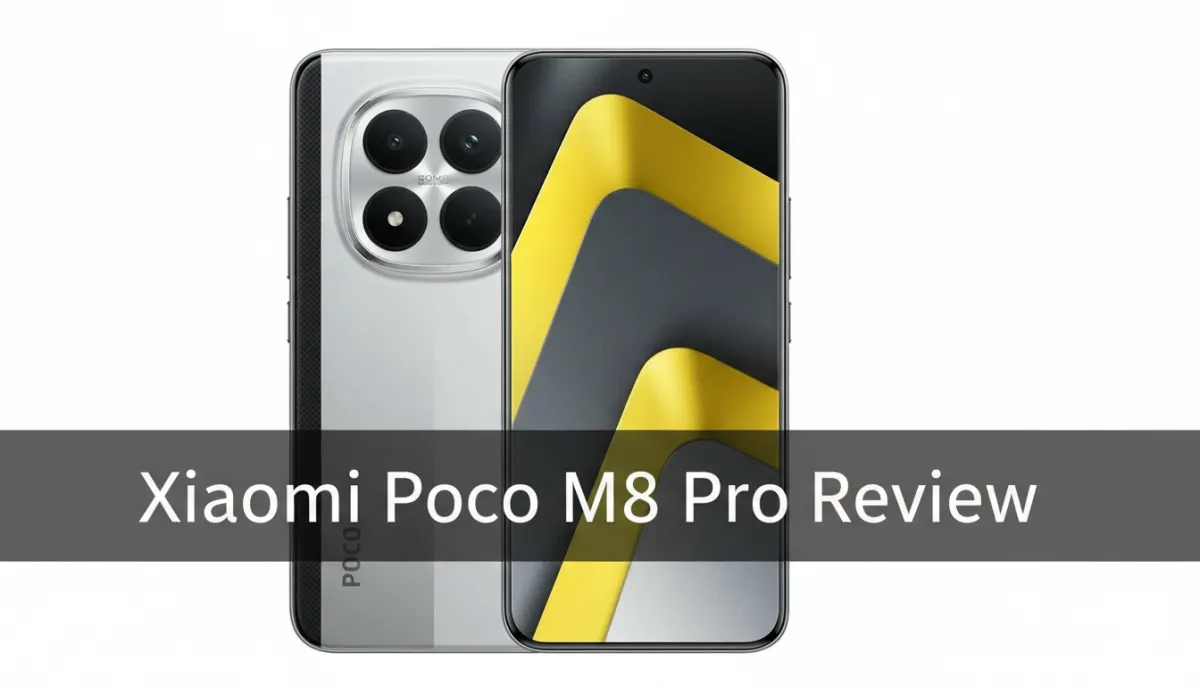
Xiaomi Poco M8 Pro Review: Big Screen, Big Battery
Not every phone needs to chase the highest benchmark scores or cram in five cameras to be worth your money. Sometimes, what you really need is a phone that handles your daily routine without fuss — one that lasts through the whole day, has a screen you actually enjoy looking at, and does not lag when you are switching between apps. The Xiaomi Poco M8 Pro is built with exactly that mindset.
Announced and released on January 8, 2026, this phone comes from Xiaomi's Poco lineup — a sub-brand known for delivering solid hardware at a sensible point. The Poco M8 Pro is not here to compete with flagship phones. It is here to be a dependable, everyday device for people who want reliability over raw power. Let us go through it section by section and see how it actually holds up.
Xiaomi Poco M8 Pro Price In Bangladesh
1) Design and Build Quality
Big Phone, Surprisingly Light Feel
The Xiaomi Poco M8 Pro has a 6.83-inch screen, which puts it firmly in the large phone category. Its dimensions are 163.3 x 78.3 x 8.3 mm, and it weighs 206 grams. That is not a light phone, but it is well-distributed — meaning it does not feel top-heavy or awkward to hold.
The build uses a glass front with Corning Gorilla Glass Victus 2 protection, a plastic frame, and a fiber-reinforced plastic back. Plastic frame and back might not sound exciting, but fiber-reinforced plastic is tougher than standard plastic — it resists flex and feels solid when you hold it. The Gorilla Glass Victus 2 on the front is genuinely good protection. Keys, coins, and small drops are much less likely to scratch the screen.
Tougher Than It Looks
One of the most practical features of the Xiaomi Poco M8 Pro is its IP68 and IP69K rating. Most of the world gets the IP69K version, which means the phone can handle high-pressure water jets and full submersion up to 1.5 metres for 30 minutes. European buyers get the IP68 standard. Either way, this phone can handle rain, spills, sweaty gym hands, and accidental bathroom incidents without drama.
Dual Nano-SIM support is standard, which is useful for people running two numbers — one personal, one for work.
2) Display
A Screen Made for Watching and Reading
The 6.83-inch AMOLED display on the Xiaomi Poco M8 Pro is one of its strongest selling points. The resolution of 1280 x 2772 pixels gives a pixel density of around 447 ppi — everything looks sharp and well-defined. Text on web pages is crisp, images pop, and watching videos feels like a genuine visual treat.
The display supports 68 billion colours, HDR10+, and Dolby Vision. This is particularly noticeable when watching HDR content on YouTube or streaming platforms — colours are richer and more natural, and dark scenes actually look dark rather than washed out.
Smooth and Gentle on the Eyes
The 120Hz refresh rate makes everything feel fluid. Scrolling through social media, swiping between home screens, or navigating apps — all of it is noticeably smoother than a standard 60Hz display. Once you get used to 120Hz, going back feels sluggish.
The 3840Hz PWM dimming rate is a feature worth highlighting. What it means practically: many displays flicker at low brightness levels in a way the naked eye cannot see, but which causes fatigue, headaches, and eye strain for sensitive users over time. The Xiaomi Poco M8 Pro's extremely high PWM rate dramatically reduces this invisible flicker, making long reading sessions or late-night browsing much more comfortable.
Peak brightness hits 3200 nits, with a measured HBM of 1800 nits. In direct sunlight, the screen remains very readable — you do not need to squint or cup your hand over it to see what is on screen.
3) Performance
Snapdragon 7s Gen 4 — Steady and Capable
The Xiaomi Poco M8 Pro is powered by the Qualcomm Snapdragon 7s Gen 4 chipset, built on a 4nm process. The CPU is an octa-core design: one Cortex-A720 core running at 2.7 GHz, three more at 2.4 GHz, and four efficiency cores at 1.8 GHz. The GPU is the Adreno 810.
In day-to-day use, this chip handles everything a typical user needs without hesitation. Opening WhatsApp, jumping to Gmail, checking a map, watching a short video, and then switching back — all of this happens cleanly with no lag or stutter. The 8GB RAM (or 12GB in the higher variant) gives the phone enough breathing room to keep several apps running in the background without having to reload them from scratch.
The AnTuTu benchmark score of around 817,000 puts it solidly in the capable mid-range category — not the fastest chip available, but more than enough for smooth daily use.
Gaming Scenarios
For gaming, the Snapdragon 7s Gen 4 handles casual and mid-level games without any issues. Games like puzzle apps, racing titles, or casual strategy games run smoothly and look great on the large AMOLED screen. More graphically demanding games run at around 55 FPS on high settings on average — playable and enjoyable, but not silky-smooth at maximum graphics like a flagship gaming chip would deliver.
If you play popular mobile titles for an hour or two in the evening, you will be happy with the experience. If you are someone who plays the most demanding games at the highest settings for three-hour sessions, this chip will feel its limits. The phone stays warm but manageable during gaming — it does not become uncomfortably hot.
Multitasking in Real Life
Imagine a morning routine: you check email, reply to a few messages, look up a recipe, play a song in the background while you cook, then switch to a video call. The Xiaomi Poco M8 Pro handles this sequence without needing to reload apps. The UFS 2.2 storage is not the fastest type available, but in everyday use — opening apps, loading pages, saving photos — the difference is not something most users will notice.
4) Camera
A Reliable Dual System for Daily Shooting
The Xiaomi Poco M8 Pro has a dual rear camera setup. The main camera is a 50MP sensor with an f/1.6 aperture, a 24mm wide lens, a 1/1.55-inch sensor, OIS (optical image stabilisation), and dual pixel PDAF autofocus. The second camera is an 8MP ultrawide with an f/2.2 aperture and a 120-degree field of view.
Real-Life Shooting Situations
Let us say you are at a weekend market. The main 50MP camera picks up a lot of detail — the texture of fabric, the colours of fresh produce, the faces in a crowd. The wide f/1.6 aperture lets in plenty of light, so even in a shaded stall the photos come out clear rather than noisy. OIS helps prevent blur if your hand moves while you press the shutter.
Switch to the ultrawide for a shot of the whole market scene — the 120-degree field of view fits far more into the frame than the main lens could. At 8MP it is not going to blow up to poster size, but for social media posts and sharing in chat groups, it is absolutely fine.
For family photos in a bright living room or outdoors in the afternoon, the main camera consistently produces images that look natural and well-exposed. The dual pixel PDAF is fast — the camera locks on to faces and subjects quickly, which matters when you are photographing children or pets who do not stay still.
Low-Light Honesty
Nighttime photography is where honesty is required. The f/1.6 aperture is better than many mid-range main cameras, which helps. But in genuinely dark conditions — a dimly lit restaurant, a night-time street with no direct lights — you will see more noise and less detail. The results are usable and look fine on a phone screen, but they are not the kind of night shots you would print and frame.
Selfie Camera — A Real Step Up
The 32MP front camera with an f/2.2 aperture is a pleasant surprise. This is a higher resolution than many front cameras in this segment, and it shows. Selfies come out sharp with good skin tone reproduction. In natural light near a window, the selfie quality is noticeably impressive. Video calls on Zoom or WhatsApp look clear and professional, which matters if you work from home or attend online meetings regularly.
Video recording goes up to 4K at supported frame rates, and the gyro-EIS keeps footage steady while you move.
5) Battery and Charging
A Battery That Goes the Distance
The Xiaomi Poco M8 Pro carries a 6500mAh Si/C (silicon-carbon) battery. This is a large capacity, and the silicon-carbon chemistry allows for more energy in a compact space — which is why the phone does not feel unusually thick despite the battery size.
In real daily life, this battery lasts comfortably through a full active day and then some. The active use score of over 16 hours of screen-on time is exceptional. Here is what that means in practice: you wake up at 7 AM, use the phone through the day for calls, messaging, social media, two or three YouTube videos, and some light gaming in the evening, and by the time you go to bed at midnight, you might still have 30 to 40 percent left. Some lighter users genuinely get through two full days on a single charge.
For heavy users — people streaming video for several hours or gaming intensively — you will likely need a charge by the end of the evening, but you will always get through the full day.
Charging Speed
The 100W wired charging is a major convenience. The phone charges from flat to full in approximately 40 minutes, which is very fast. This means that even if you wake up with a nearly dead battery, twenty minutes on the charger gives you a significant boost before heading out. The reverse wired charging at 22.5W is a handy bonus — it lets you charge a friend's phone or wireless earbuds directly from the Poco M8 Pro, turning it into a mini power bank when needed.
6) Software and Features
Android 15 with HyperOS 2 and Four Years of Updates
The Xiaomi Poco M8 Pro ships with Android 15 and Xiaomi's HyperOS 2 on top. HyperOS 2 is a polished and feature-rich interface that feels clean and snappy on this hardware. Customisation options are plentiful — themes, wallpapers, notification styles, and always-on display options all let you make the phone feel personal.
One of the most important software details is the update commitment: Xiaomi promises up to 4 major Android upgrades for this phone. This means the Poco M8 Pro should continue receiving Android updates for several years, which extends the useful life of the device considerably.
The under-display optical fingerprint scanner works reliably and quickly. It is not quite as fast as some ultrasonic scanners, but it recognises your fingerprint accurately on the first try in most conditions. Other sensors include an accelerometer, gyroscope, compass, and proximity sensor.
The infrared blaster is a practical bonus. You can set it up to control your TV, air conditioner, and other home appliances directly from the phone. It sounds like a small thing, but it genuinely saves time when you cannot find the remote.
7) Connectivity and Other Features
The Xiaomi Poco M8 Pro is fully 5G-ready with an impressive list of supported 5G bands — covering SA and NSA modes across a wide range of frequencies. Whether you are on a fast 5G network or a reliable 4G connection, the phone handles it all.
Wi-Fi 6 (and Wi-Fi 6E in some markets) ensures fast and stable wireless speeds at home or in the office. Bluetooth 5.4 covers wireless headphones and accessories with stable connectivity. NFC is available in most markets, enabling contactless mobile payments.
The GPS system covers the standard satellite networks — GPS, Galileo, GLONASS, QZSS, and BDS — for accurate and reliable navigation, whether you are using maps to commute or exploring a new city.
The stereo speakers with Dolby Atmos support deliver surprisingly good audio. Music, videos, and games all sound full and rich. The loudspeaker scores an excellent -19.5 LUFS in testing, which puts it among the louder and clearer speakers in its category. There is no 3.5mm headphone jack — you will need Bluetooth headphones or a USB-C adapter for wired listening.
8) Who Should Buy This Phone?
The Xiaomi Poco M8 Pro is a great fit for students who spend long hours on their phone for studying, communication, and entertainment — the long battery life and comfortable display make all-day use easy.
It suits working professionals who need a reliable phone for calls, email, documents, and video meetings. The 32MP selfie camera in particular is a standout for video calls, making you look sharp on screen.
People who watch a lot of video content — YouTube, streaming shows, or locally downloaded movies — will love the large, bright AMOLED display with Dolby Vision. The Dolby Atmos stereo speakers add to the experience.
It is also ideal for older users or first-time smartphone buyers who want something simple to understand, reliable all day, and backed by years of software support.
9) Who Should Avoid It?
Heavy mobile gamers who play graphically demanding titles at maximum settings for hours on end will find the Snapdragon 7s Gen 4 hits its limits. The 55 FPS average on high settings is playable but not the fluid 90+ FPS experience a gaming-focused chip would deliver.
Night photography enthusiasts will be disappointed in dark environments. The camera is genuinely good in daylight but struggles in low light situations more than higher-end options.
People who prefer compact, one-hand-friendly phones will find the 6.83-inch screen and 206-gram weight too large and heavy for comfortable single-hand use throughout the day.
Anyone who relies on wired headphones daily will also need to carry a USB-C adapter, since the 3.5mm jack is absent.
10) Pros and Cons
Pros
Enormous 6500mAh battery with an outstanding 16+ hour screen-on time estimate
100W fast wired charging — full charge in around 40 minutes
Beautiful 6.83-inch AMOLED display with 120Hz, Dolby Vision, and HDR10+
3840Hz PWM dimming — much easier on the eyes during long sessions
IP68/IP69K water and dust resistance — serious protection for daily life
Gorilla Glass Victus 2 screen protection
Impressive 32MP selfie camera — great for video calls and selfies
Dolby Atmos stereo speakers with excellent loudness and clarity
4 major Android upgrades promised — long software support life
Infrared blaster for home appliance control
NFC for contactless payments
5G-ready across a wide range of bands
Cons
UFS 2.2 storage is not the fastest available — slightly slower app loading than newer standards
Low-light camera performance is average
No 3.5mm headphone jack
No microSD card slot — storage cannot be expanded
Plastic frame (though fiber-reinforced) may not appeal to those who prefer metal or glass builds
Gaming performance on maximum settings is limited for heavy mobile gamers
11) Final Verdict
The Xiaomi Poco M8 Pro makes a clear and honest case for itself: it is a big-screen phone with an exceptional battery, a beautiful display, a capable selfie camera, and long software support, all in a durable and water-resistant package.
It is not trying to be a photography powerhouse or a gaming beast. It is trying to be the phone you can rely on every single day without thinking about it — and at that, it succeeds very well. The 16+ hour screen-on time alone puts it ahead of most phones in terms of battery endurance, and 100W charging means that when you do need to top up, you are not waiting long.
If you are looking for a phone that handles daily communication, content consumption, social media, work tasks, and casual gaming — all without running out of battery before the day is done — the Xiaomi Poco M8 Pro is a very smart, practical choice.